

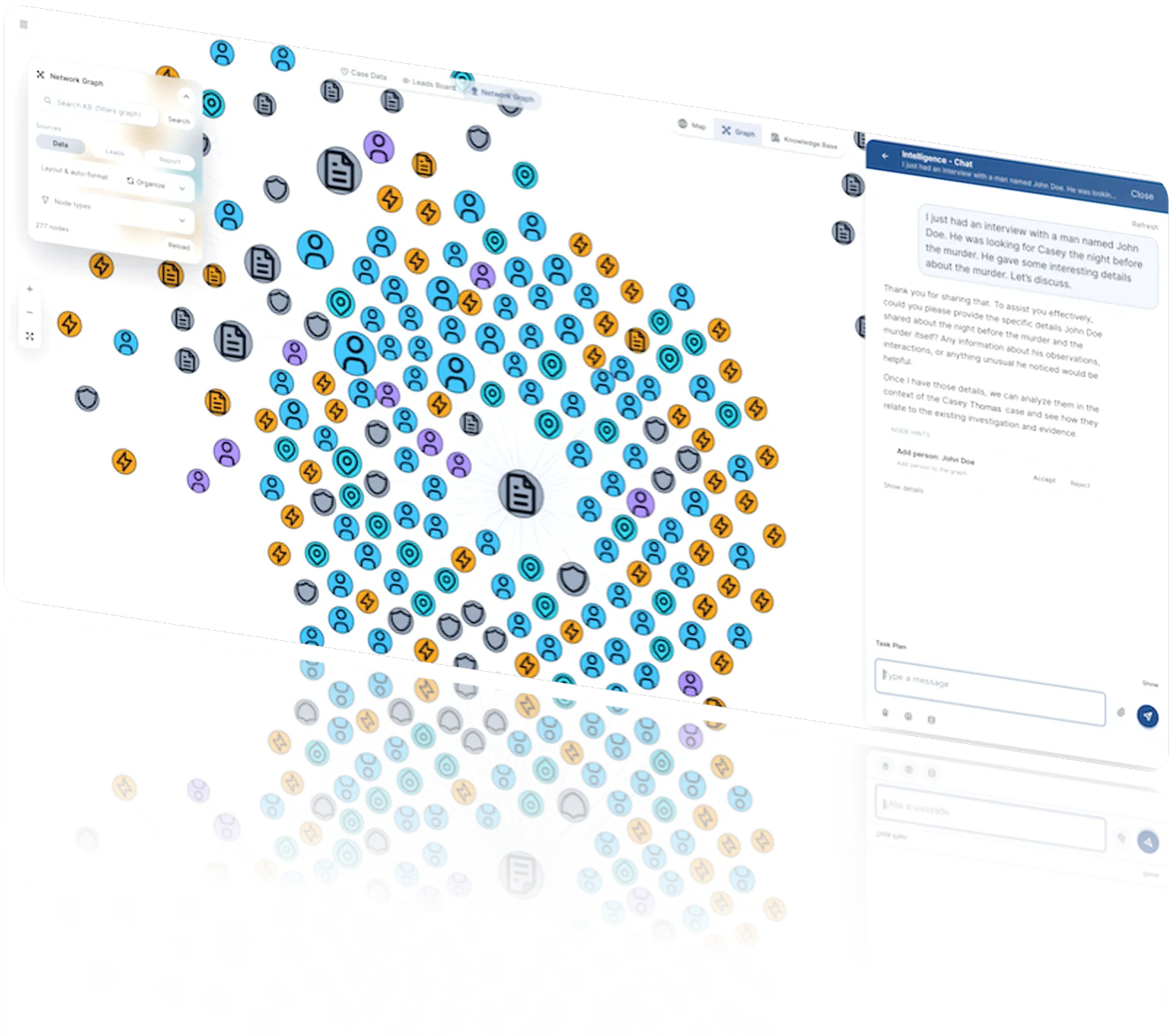
Less synthesis. More investigating.
Cut the manual reconciliation work that builds up when notes, reports, and media stay scattered across a case.
PI is built for investigative sense-making: reducing overload, surfacing overlooked connections, working with messy materials, and helping teams change angles without losing the thread.
Cut the manual reconciliation work that builds up when notes, reports, and media stay scattered across a case.
Spot connections, contradictions, and gaps that are easy to overlook when the story is spread across many sources.
Handle unstructured, messy material without forcing a new evidence-prep routine just to get started.
Revisit timelines, people, places, and events while staying grounded in where each detail came from.
Backed by source-linked answers.
Simplifying complex multi-source investigations.
Work with documents, audio, images, and notes without forcing a new prep process.
Maintain context across many sources so the story stays understandable as new material arrives.
Identify conflicts worth re-checking and gaps that can sharpen the next best actions.
Keep key facts and connections tied to the original materials they came from.
Draft clearer notes and summaries for review, while keeping human judgment in the loop.
Share a consistent case picture so handoffs do not reset understanding.
Many tools help you store evidence or find a document. The hard part is the ongoing sense-making: reconciling what is new, what conflicts, what connects, and what is still unknown.
Request a demo and we will walk through how PI helps investigators reason clearly through complex cases.